
VIDA
Armour 1000VA UPS 600W Battery Backup – LCD, AVR & USB Monitoring
- SKU:
- ARM1000
- UPC:
- 5056733100499
- MPN:
- ARM1000
- Availability:
- Free Click & Collect in Peterborough. UK delivery also available


Description
Armour 1000VA 600W UPS – Line-Interactive Battery Backup, AVR, LCD & USB Monitoring
The VIDA Armour ARM1000 1000VA / 600W UPS is a line-interactive uninterruptible power supply designed to protect compatible desktop PCs, office computers, NAS systems, networking equipment, CCTV systems and other sensitive electronics from power cuts, voltage fluctuations, surges and electrical noise.
With a maximum capacity of 1000VA / 600W, built-in Automatic Voltage Regulation (AVR), two maintenance-free 12V 7Ah sealed lead-acid batteries and a manufacturer-quoted backup time of approximately 15–20 minutes depending on load, the ARM1000 provides valuable time to save work, maintain short-term connectivity or perform an orderly shutdown when mains electricity fails.
The UPS provides six AC outputs comprising three standard UK Type-G mains sockets and three IEC sockets. It also includes a USB Type-B monitoring connection, two RJ45 network-line protection ports, LCD status display, LED indicators and audible alarms.
The exact product supplied by Memox is the VIDA Armour ARM1000, manufacturer part number ARM1000, Memox SKU ARM1000, EAN/GTIN 5056733100499.
Key Features of the VIDA Armour ARM1000 UPS
- 1000VA / 1kVA apparent power capacity
- 600W maximum real-power output
- Line-interactive UPS technology
- Built-in Automatic Voltage Regulation / AVR
- Approximately 6ms or less transfer time
- 2 × 12V 7Ah sealed lead-acid batteries
- Maintenance-free VRLA battery technology
- Approximately 15–20 minutes quoted runtime depending on load
- Approximately 8 hours to recharge to around 90% capacity
- 6 AC output sockets in total
- 3 × UK Type-G / BS 1363 mains sockets
- 3 × IEC output sockets
- UK Type-G mains input
- USB Type-B monitoring connection
- 2 × RJ45 network-line protection ports
- LCD status display
- LED indicators
- Audible alarm
- Cold-start capability
- 320-joule surge-protection specification
- Over-voltage protection
- Under-voltage protection
- Full-time EMI/RFI filtering
- Relay protection
- 0°C to 40°C operating-temperature range
- 20% to 90% non-condensing operating humidity
- Up to approximately 45dB noise at 1 metre
- Compact desktop/tower form factor
- 1-year manufacturer warranty
What Is the Armour ARM1000 UPS?
The Armour ARM1000 is a line-interactive UPS with battery backup and automatic voltage regulation.
During normal operation, the UPS monitors the incoming mains supply and powers connected equipment from the electrical grid. Its AVR system is designed to correct certain voltage fluctuations without immediately switching to battery operation.
If the incoming mains supply fails or moves outside the supported operating conditions, the UPS transfers the connected equipment to its internal battery-powered inverter.
What Does a UPS Protect Against?
The ARM1000 is designed to help protect compatible equipment against common power problems including:
- Power cuts / blackouts
- Voltage sags
- Brownouts
- Supported over-voltage conditions
- Electrical surges
- Mains-voltage fluctuations
- EMI/RFI electrical noise
A UPS can therefore provide both temporary backup power and another layer of protection between sensitive electronics and the mains electricity supply.
1000VA / 600W Power Capacity Explained
The ARM1000 has two important power ratings:
- 1000VA / 1kVA apparent power
- 600W maximum real power
1000VA Does Not Mean 1000W
VA and watts are related but they are not the same measurement.
The ARM1000 should therefore not be advertised as a 1000W UPS.
The maximum manufacturer-rated real-power output is 600W.
Total Connected Equipment Must Stay Below 600W
The combined load of all equipment connected to the UPS must remain within its electrical limits.
For example, if you connect:
- A desktop PC
- A monitor
- A router
- A network switch
their combined maximum power requirement must still remain within the ARM1000's 1000VA / 600W capacity.
Leave Headroom When Choosing a UPS
For a practical installation, it is sensible to leave some unused UPS capacity rather than designing a system that continuously operates at the absolute 600W maximum.
Additional headroom can help accommodate:
- Short power-demand peaks
- Changes in CPU load
- Changes in GPU load
- Additional peripherals
- Future hardware upgrades
- Battery ageing
Line-Interactive UPS with AVR
The ARM1000 uses line-interactive UPS topology.
This is commonly used for home offices, desktop computers, networking equipment and small-business installations because it combines battery backup with automatic mains-voltage correction.
What Does AVR Do?
Automatic Voltage Regulation helps stabilise supported changes in mains voltage without unnecessarily draining the UPS battery.
For example, when incoming mains voltage temporarily rises or falls within the AVR's correction capability, the UPS can regulate the supply rather than immediately switching entirely to battery operation.
Why AVR Helps Battery Life
If every small voltage fluctuation caused the UPS to switch to battery, the batteries would experience more discharge cycles.
AVR reduces unnecessary battery use during supported voltage variations, helping reserve battery capacity for genuine outages and more severe supply problems.
Important Waveform Information
The Armour ARM1000 uses different waveforms depending on its operating mode.
While Running from Mains
VIDA specifies:
- Sine-wave mains operation
While Running from Battery
VIDA specifies:
- Square-wave inverter output
The ARM1000 Is Not a Pure Sine Wave UPS
This distinction is important.
The ARM1000 should not be described as a pure sine-wave UPS.
When mains electricity is available, connected equipment receives the normal AC supply through the UPS. During battery operation, however, the inverter output is specified as a square wave.
Check Sensitive Equipment Requirements
Many everyday computers, networking devices and electronic power adapters can operate with conventional UPS inverter output, but some sensitive equipment or power supplies may specifically require a pure sine-wave UPS.
If your equipment manufacturer states that pure sine-wave battery power is required, choose a UPS specifically rated for pure sine-wave output rather than the ARM1000.
Need Pure Sine Wave?
Within the Armour range, higher-specification models such as the ARM2000 are designed around pure sine-wave battery output.
Always compare the exact equipment requirement with the UPS waveform before purchase.
Approximately 6ms Transfer Time
VIDA specifies a mains-to-battery transfer time of approximately 6 milliseconds or less for the ARM1000.
This is the brief period required for a line-interactive UPS to detect a mains failure and switch the connected load to battery-powered inverter operation.
Why Transfer Time Matters
Compatible computer power supplies are designed to tolerate very short interruptions.
The ARM1000's approximately 6ms transfer time is designed to allow compatible connected equipment to remain operating while the UPS changes from mains power to battery operation.
Two 12V 7Ah VRLA Batteries
The ARM1000 contains:
- 2 × 12V 7Ah sealed lead-acid batteries
These are maintenance-free VRLA batteries.
What Does VRLA Mean?
VRLA stands for Valve-Regulated Lead-Acid.
The sealed design means users do not need to refill battery electrolyte during normal UPS operation.
UPS Batteries Wear Out Over Time
UPS batteries are consumable components.
Their available capacity gradually decreases according to factors including:
- Age
- Number of discharge cycles
- Depth of each discharge
- Ambient temperature
- Storage conditions
- Connected load
A UPS that originally provided substantial runtime may therefore provide less backup time after several years of battery use.
15–20 Minutes Quoted Backup Time
VIDA specifies approximately 15–20 minutes of backup time depending on connected load.
20 Minutes Is Not Guaranteed
Battery runtime is strongly affected by power consumption.
A lightly loaded ARM1000 can run longer than the same unit supplying a high-power desktop computer close to its maximum rating.
The quoted 15–20 minute figure should therefore be understood as a manufacturer runtime guideline rather than a guaranteed runtime under every load.
What Affects UPS Runtime?
Actual battery runtime depends on:
- Total connected wattage
- Battery age
- Battery condition
- Ambient temperature
- Number of previous discharge cycles
- Power factor of connected equipment
- Actual workload at the moment the mains fails
Lower Loads Normally Provide Longer Runtime
A router and network switch may consume only a small fraction of the ARM1000's capacity and can therefore achieve substantially more useful backup time than a heavily loaded workstation.
Higher Loads Reduce Runtime
A desktop PC running demanding applications can consume significantly more power.
As the load approaches the UPS's maximum rating, the amount of available battery runtime falls.
UPS Backup Is Designed for Continuity and Safe Shutdown
The ARM1000 should primarily be considered a short-duration battery-backup system.
Its purpose is to provide enough time to:
- Continue through a short power interruption
- Save open files
- Finish critical tasks
- Safely shut down a PC
- Safely shut down compatible NAS or server equipment
- Keep essential networking equipment operating temporarily
It is not intended as a replacement for a long-runtime generator or large battery-storage system.
Approximately 8-Hour Recharge Time
VIDA specifies approximately 8 hours to recharge the batteries to around 90% capacity.
Recharge time can vary depending on battery condition and the depth of the previous discharge.
Allow the UPS to Recharge After a Long Outage
If the batteries have been heavily discharged during a power cut, available runtime will remain reduced until they recharge.
For this reason, the UPS should normally remain connected to the mains during everyday operation.
Six AC Output Sockets
The ARM1000 provides a particularly flexible combination of UK and IEC power connections.
There are six AC output sockets in total:
- 3 × UK Type-G / BS 1363 mains sockets
- 3 × IEC sockets
Three UK Type-G Outputs
The three standard UK sockets are convenient for equipment supplied with normal UK three-pin plugs.
Examples include:
- Desktop computers
- Monitors
- Routers
- Network switches
- NAS power adapters
- Other compatible electronics
Three IEC Outputs
The three IEC connections are useful for traditional computer and professional IT equipment using IEC power leads.
This can simplify installation in an office or IT environment where IEC-connected devices are common.
Six Outlets Do Not Mean Six Times the Power
The six sockets all share the ARM1000's overall capacity.
Using every socket does not increase the UPS rating beyond:
- 1000VA
- 600W
Always calculate the combined load of all connected equipment.
UK Type-G Mains Connection
The ARM1000 is designed for UK mains installations and uses a Type-G / BS 1363 mains plug.
VIDA specifies nominal operation around 230–240VAC.
LCD Status Display
The front-mounted LCD display provides useful UPS operating information directly from the unit.
This allows users to monitor the UPS without having to rely entirely on a connected computer.
Real-Time UPS Information
The display is designed to provide at-a-glance information about the current UPS operating state and battery condition.
This can be particularly useful in:
- Home offices
- Small offices
- Server rooms
- Networking installations
- CCTV installations
LED Status Indicators
The ARM1000 also provides LED indicators to supplement the LCD display.
These provide additional visual feedback about the operating status of the UPS.
Audible Alarm System
An integrated audible alarm alerts the user to important UPS conditions.
Depending on operating state, this may include warnings relating to:
- Battery operation
- Low battery
- Power interruption
- Abnormal UPS conditions
Refer to the supplied VIDA manual for the exact alarm patterns.
USB Type-B Monitoring
The ARM1000 includes a USB Type-B monitoring port.
The USB connection allows a compatible computer to communicate with the UPS for power monitoring and management.
What Can USB UPS Monitoring Be Used For?
Depending on the connected computer, operating system and supported monitoring software, USB communication may allow the user to monitor:
- UPS status
- Battery condition
- Mains status
- Power events
Automatic Shutdown Depends on Software Compatibility
The presence of a USB connection does not automatically guarantee unattended shutdown support with every computer, server or NAS.
If automatic shutdown during a prolonged outage is important, check that the exact operating system or NAS platform supports the UPS communication method before relying on the feature.
Can the ARM1000 Be Used with a NAS?
The ARM1000 can provide battery backup for compatible NAS systems whose total power requirement is within the UPS rating.
The USB monitoring connection may also be useful where the NAS supports compatible UPS signalling.
Check NAS USB UPS Compatibility
Before relying on automated NAS shutdown, confirm compatibility with the exact NAS model and operating system.
Electrical compatibility and USB shutdown-software compatibility are separate considerations.
Two RJ45 Network Protection Ports
The ARM1000 provides two RJ45 ports configured for network-line pass-through protection.
A network cable can pass through the UPS protection circuitry using the input and output connections.
RJ45 Ports Are Not a Network Switch
The two RJ45 ports do not function as two independent Ethernet LAN ports.
They are intended for protected network-line pass-through and should not be counted as a built-in Ethernet switch.
320-Joule Surge Protection
VIDA's ARM1000 technical specification lists approximately 320 joules of surge protection.
This adds another layer of protection for compatible connected electronics against supported short-duration electrical surges.
UPS Surge Protection Has Limits
No desktop UPS can guarantee protection against every possible lightning strike or severe electrical fault.
Correct building wiring, earthing and upstream protection remain important.
Over-Voltage and Under-Voltage Protection
The ARM1000 provides protection against supported over-voltage and under-voltage conditions.
Combined with AVR and battery backup, this allows the UPS to address more types of power disturbance than a simple surge-protected extension lead.
Full-Time EMI/RFI Filtering
VIDA specifies full-time EMI/RFI noise suppression.
EMI and RFI refer to electromagnetic and radio-frequency interference that can travel through electrical wiring.
Filtering is designed to help reduce this electrical noise before it reaches compatible connected equipment.
Relay Protection
VIDA's ARM1000 design incorporates relay protection.
The manufacturer's technical documentation highlights a relay safety system that disconnects the UPS appropriately when mains power is removed, helping reduce the risk of live voltage being present where it should not be.
Cold-Start Capability
The ARM1000 supports cold start.
This allows the UPS to start from its internal batteries under supported conditions even when normal mains electricity is unavailable.
Cold Start Uses Battery Capacity
Cold-start operation does not provide free additional runtime.
Any equipment powered while mains electricity is unavailable consumes energy from the internal batteries.
Suitable for Desktop PCs
The Armour ARM1000 is well suited to many standard desktop-computer installations where total power consumption remains comfortably within 600W and the computer power supply is compatible with the UPS's battery waveform.
Potential configurations include:
- Business desktop PC
- Office monitor
- Router
- Network switch
- Selected low-power peripherals
Suitable for Home Offices
A short power interruption can be enough to lose unsaved work or interrupt an important video call.
The ARM1000 can provide temporary backup power to compatible home-office equipment such as:
- Desktop PC
- Monitor
- Router
- Broadband modem
- Small network switch
- NAS
Suitable for Routers and Network Equipment
Networking equipment generally consumes considerably less power than a desktop PC.
The ARM1000 can therefore be useful for keeping compatible:
- Internet routers
- Broadband modems
- Network switches
- Wireless access points
- Firewalls
running through shorter power interruptions.
Internet Service May Still Depend on External Infrastructure
Keeping your router powered does not guarantee that the external broadband network will continue operating during a local or regional power failure.
Suitable for CCTV and NVR Systems
The ARM1000 can also provide backup power to compatible security equipment whose total electrical load is within the UPS limits.
Examples can include:
- Network Video Recorders / NVRs
- Digital Video Recorders / DVRs
- PoE switches
- Routers
- Selected CCTV equipment
Always calculate the combined load, particularly where a PoE switch powers multiple cameras.
Can the ARM1000 Be Used with a Gaming PC?
It can be used with a compatible gaming PC only where both the power requirement and PSU waveform requirements are suitable.
Check the Actual PC Power Draw
A computer having an 850W or 1000W PSU does not necessarily continuously consume 850W or 1000W.
The PSU rating describes the maximum capability of the computer power supply rather than the computer's normal electricity consumption.
However, a high-performance gaming PC can exceed the ARM1000's 600W maximum under heavy load.
Check the PSU's Battery-Waveform Requirement
The ARM1000 uses a square-wave inverter during battery operation.
For high-end gaming PCs or other equipment whose manufacturer recommends or requires pure sine-wave UPS power, choose an appropriate pure sine-wave UPS instead.
ARM1000 vs ARM2000
The ARM1000 and ARM2000 target different power requirements.
ARM1000
- 1000VA
- 600W
- 2 × 12V 7Ah batteries
- Square-wave inverter during battery operation
- 3 UK + 3 IEC outputs
- Suitable for lower-power compatible PC and networking workloads
ARM2000
- 2000VA
- 1600W
- Higher battery capacity
- Pure sine-wave output
- Better suited to more demanding compatible computer and professional workloads
If pure sine-wave battery output or substantially more power capacity is required, the ARM2000 is the more appropriate Armour model.
What Should I Connect to the UPS?
Battery capacity should be prioritised for equipment that needs to stay operating long enough to save data or shut down safely.
Examples include:
- Desktop computer
- Main monitor
- NAS
- Router
- Network switch
- NVR
- Other essential compatible IT equipment
Avoid Unnecessary Loads
Connecting non-essential equipment reduces the runtime available to important devices.
During a power cut, battery energy should preferably be reserved for equipment that genuinely needs temporary backup power.
High-Inrush Equipment Requires Caution
Some equipment draws substantially more power when starting than during normal operation.
Examples can include:
- Motors
- Compressors
- Large pumps
- Heating equipment
- Laser printers
- Other high-inrush electrical devices
Do not assume a device is suitable merely because its normal running power is below 600W.
Check the device manufacturer's UPS requirements and start-up current.
Laser Printers Should Be Checked Carefully
Laser printers can draw a large short-duration current when their fuser heater starts.
For that reason, a laser printer should not automatically be connected to the battery-backed outputs of a 600W UPS without checking its peak electrical requirement.
Not a Whole-House Backup System
The ARM1000 is a desktop UPS designed to protect selected equipment.
It is not intended to replace:
- A standby generator
- A whole-house battery
- An extended-runtime UPS system
- A large portable power station
Operating Temperature
VIDA specifies an operating-temperature range of:
- 0°C to 40°C
Operating Humidity
The specified operating relative humidity is:
- 20% to 90%
- Non-condensing
Keep the UPS Cool and Ventilated
Heat can significantly reduce lead-acid battery life.
Install the ARM1000 in a dry, well-ventilated location away from:
- Radiators
- Heaters
- Direct sunlight
- Water
- High humidity
- Blocked ventilation areas
Noise Level
VIDA specifies noise of up to approximately 45dB measured at 1 metre.
Actual perceived sound can vary according to:
- Operating mode
- Room acoustics
- Battery operation
- Load
Compact Desktop UPS
The ARM1000 uses a desktop/tower form factor suitable for placement beside or underneath a workstation.
VIDA's technical data gives dimensions of approximately:
- 125mm wide
- 225mm high
- 320mm deep
Net weight is approximately 9.7kg.
Allow Space for Ventilation
Do not install the UPS tightly against walls or other objects that block its ventilation openings.
Also allow sufficient rear space for power, USB and network cables.
How to Choose the Right UPS Size
Before buying a UPS, calculate the maximum combined wattage of all equipment that will be connected.
Step 1 – Identify the Devices
List the devices that need battery protection.
Step 2 – Find Their Maximum Power Requirement
Check equipment labels, manufacturer specifications or measured consumption.
Step 3 – Add the Loads Together
The combined requirement must remain safely below the UPS's 600W maximum.
Step 4 – Leave Headroom
Avoid choosing a UPS that will operate continuously at its maximum capacity.
Step 5 – Check Waveform Requirements
If the connected equipment requires pure sine-wave battery power, the ARM1000 is not the appropriate model.
What Is Included?
- 1 × VIDA Armour ARM1000 UPS
- 2 × internal 12V 7Ah VRLA batteries
- UK mains lead
- USB monitoring cable
- User guide / manual
VIDA Armour ARM1000 Technical Summary
- Brand: VIDA
- Range: Armour
- Model: ARM1000
- MPN: ARM1000
- Memox SKU: ARM1000
- EAN / GTIN: 5056733100499
- UPS Type: Line-Interactive
- Capacity: 1000VA / 1kVA
- Maximum Real Power: 600W
- AVR: Built-in Automatic Voltage Regulation
- Mains Waveform: Sine Wave
- Battery Inverter Waveform: Square Wave
- Pure Sine Wave on Battery: No
- Transfer Time: Approximately ≤6ms
- Input: 230 / 240VAC with relay protection
- Output: 230 / 240VAC
- Battery Technology: Sealed Lead-Acid / VRLA
- Battery Configuration: 2 × 12V 7Ah
- Maintenance-Free Batteries: Yes
- Quoted Runtime: Approximately 15–20 minutes depending on load
- Recharge: Approximately 90% capacity after 8 hours
- Typical Surge Protection: 320 Joules
- Total AC Outputs: 6
- UK Outputs: 3 × Type-G / BS 1363
- IEC Outputs: 3
- USB: 1 × USB Type-B monitoring port
- RJ45: 2 × network-line protection ports
- Display: LCD
- LED Indicators: Yes
- Audible Alarm: Yes
- Cold Start: Yes
- Over-Voltage Protection: Yes
- Under-Voltage Protection: Yes
- EMI/RFI Filtering: Yes
- Relay Protection: Yes
- Operating Temperature: 0°C to 40°C
- Operating Humidity: 20–90% non-condensing
- Noise: Up to approximately 45dB at 1 metre
- Dimensions: Approximately 125 × 225 × 320mm (W × H × D)
- Weight: Approximately 9.7kg
- Colour: Black
- Form Factor: Desktop / Tower
- Warranty: 1 year
Important Waveform Note
The ARM1000 is not a pure sine-wave UPS during battery operation.
VIDA specifies sine-wave mains input and square-wave inverter output.
If your computer, server, audio equipment, medical equipment or other sensitive device specifically requires pure sine-wave battery power, choose an appropriate pure sine-wave UPS.
Important 1000VA vs 600W Note
The ARM1000 is rated at 1000VA but only 600W maximum real power.
Do not calculate equipment compatibility using the 1000VA number alone.
Important Runtime Note
The manufacturer-quoted 15–20 minute runtime is load dependent.
A heavily loaded desktop computer can provide considerably less runtime than lower-power equipment such as a router or network switch.
Important Six-Outlet Note
The UPS provides:
- 3 × UK Type-G sockets
- 3 × IEC sockets
for a total of six AC output connections.
All six outputs share the same 1000VA / 600W UPS capacity.
Important USB Monitoring Note
The USB Type-B connection provides UPS monitoring capability.
Automatic computer, server or NAS shutdown depends on compatible software and host-device support and is not guaranteed for every operating system or NAS platform.
Important RJ45 Note
The two RJ45 connections are used for protected network-line pass-through.
They do not operate as an Ethernet switch and do not add additional LAN ports.
Important Battery Note
The two internal 12V 7Ah VRLA batteries are consumable components.
Available runtime gradually decreases as UPS batteries age and may eventually require battery replacement.
Important Recharge Note
VIDA specifies approximately 8 hours to recharge the batteries to around 90% capacity.
After a substantial power outage, the UPS may therefore provide reduced backup time until charging is complete.
Important High-Power PC Note
A high-performance gaming PC or workstation may approach or exceed the ARM1000's 600W rating when heavily loaded.
Check actual maximum system consumption rather than relying only on the wattage printed on the PC power supply.
Important Installation Note
Install the ARM1000 indoors on a stable surface in a dry, ventilated environment between 0°C and 40°C.
Do not block ventilation openings or place the UPS close to heaters, radiators, direct sunlight or water.
Important Battery Safety Note
The UPS contains sealed lead-acid batteries capable of delivering high electrical current.
Do not dismantle, short-circuit, burn or improperly dispose of the batteries. Follow VIDA's instructions and applicable battery recycling requirements when battery replacement is eventually required.
1-Year VIDA Manufacturer Warranty
The Armour ARM1000 is supplied with a 1-year manufacturer warranty, subject to VIDA's applicable terms and conditions.
Why Choose the VIDA Armour ARM1000 1000VA UPS?
The VIDA Armour ARM1000 offers a useful balance of power capacity, connectivity and battery protection for compatible home-office and small-business IT equipment.
Its 1000VA / 600W rating provides enough capacity for many desktop computers, monitors, routers, network switches, NAS systems and CCTV installations, while two 12V 7Ah VRLA batteries provide temporary backup power when the mains fails.
Built-in AVR helps stabilise supported voltage fluctuations without unnecessarily using the battery, while the approximately 6ms transfer time allows compatible equipment to transition rapidly from mains power to battery operation.
Three standard UK sockets and three IEC connections provide flexible power connectivity, while USB Type-B monitoring and two RJ45 protection ports add useful management and network-protection functionality.
The LCD display, LED status indicators and audible alarms provide clear information about UPS operation, while over-voltage, under-voltage, surge, EMI/RFI and relay protection provide additional safeguards for connected electronics.
The ARM1000 is particularly well suited to users who need short-term 1000VA battery backup for PCs, office equipment, NAS devices, routers, networking equipment and CCTV systems without requiring the higher cost and capacity of a larger pure sine-wave UPS.
Choose the Armour ARM1000 when you need a 1000VA / 600W line-interactive UPS with AVR, six AC outputs, 15–20 minute load-dependent backup, LCD display, USB monitoring, RJ45 protection and two maintenance-free 12V 7Ah batteries.
Specification
VIDA Armour ARM1000 1000VA 600W UPS Specifications
The VIDA Armour ARM1000 is a 1000VA / 600W line-interactive uninterruptible power supply designed to provide battery backup, Automatic Voltage Regulation (AVR), surge protection and USB monitoring for compatible desktop PCs, office computers, NAS systems, networking equipment and other electronics.
The ARM1000 includes two maintenance-free 12V 7Ah VRLA batteries, six AC output connections, LCD and LED status indicators, USB Type-B monitoring and RJ45 network-line protection.
General Information
| Brand | VIDA |
|---|---|
| Product Range | Armour |
| Model | ARM1000 |
| Manufacturer Part Number | ARM1000 |
| Memox SKU | ARM1000 |
| EAN / GTIN | 5056733100499 |
| Product Type | Uninterruptible Power Supply / UPS |
| Form Factor | Desktop / Tower |
| Colour | Black |
UPS Technology
| UPS Topology | Line-Interactive |
|---|---|
| Automatic Voltage Regulation | Yes |
| AVR | Built-in |
| Battery Backup | Yes |
| Cold Start | Yes |
| Intelligent CPU Control | Yes, listed in VIDA ARM1000 technical documentation |
| Wide Input Range | Yes, listed in VIDA ARM1000 technical documentation |
Power Capacity
| Apparent Power Capacity | 1000VA / 1kVA |
|---|---|
| Maximum Real Power Output | 600W |
| VA-to-Watt Power Ratio | 0.6 based on the published 1000VA / 600W ratings |
| 1000VA Equals 1000W | No |
| Maximum Manufacturer-Rated Wattage | 600W |
Waveform
| Current VIDA Waveform Description | Sine / Square |
|---|---|
| Mains / Line Mode | Sine wave |
| Battery / Inverter Mode | Square wave |
| Pure Sine Wave on Battery | No |
| Suitable for Equipment Requiring Pure Sine Wave | No – choose a specifically rated pure sine-wave UPS where required |
Input Power
| Nominal Input Voltage | 230V / 240V AC |
|---|---|
| Input Connection | UK Type-G mains connection |
| Relay Protection | Yes |
| UK Mains Use | Yes |
Output Power
| Nominal Output Voltage | 230V / 240V AC |
|---|---|
| Maximum Output | 600W |
| Maximum Apparent Output | 1000VA |
| Output Socket Types | UK Type-G and IEC |
Transfer Time
| Line Mode to Battery Mode | Approximately 6ms or less |
|---|---|
| Zero Transfer Time | No |
| UPS Type | Line-Interactive rather than online double-conversion |
Automatic Voltage Regulation
| AVR Supported | Yes |
|---|---|
| Purpose | Helps compensate for supported voltage fluctuations without immediately switching to battery operation |
| Brownout / Voltage Sag Assistance | Yes, within the UPS AVR operating range |
| Battery Conservation | AVR can reduce unnecessary battery use during correctable voltage fluctuations |
Battery Specifications
| Battery Technology | Sealed Lead-Acid / VRLA |
|---|---|
| Maintenance-Free | Yes |
| Battery Voltage | 12V per battery |
| Battery Capacity | 7Ah per battery |
| Number of Batteries | 2 |
| Battery Configuration | 2 × 12V 7Ah VRLA |
| Batteries Included | Yes |
Battery Runtime
| Manufacturer-Quoted Runtime | Approximately 15–20 minutes depending on connected load |
|---|---|
| 20-Minute Runtime Guaranteed | No |
| Runtime at Full 600W Load | Not separately published as a guaranteed figure |
| Runtime Depends On | Connected wattage, battery age, battery condition, temperature and operating conditions |
Battery Recharge
| Battery Recharge Time | Approximately 8 hours |
|---|---|
| Charge Level After Quoted Recharge Time | Approximately 90% |
| Recharge Time Guaranteed | No – charging time may vary according to battery condition and depth of discharge |
AC Output Connections
| Total AC Output Connections | 6 |
|---|---|
| UK Type-G / BS 1363 Sockets | 3 |
| IEC Output Sockets | 3 |
| Total Output Capacity | All outlets share the UPS's overall 1000VA / 600W rating |
UK Socket Outputs
| UK Sockets | 3 |
|---|---|
| Socket Standard | Type-G / BS 1363 |
| Standard UK 3-Pin Plug Compatible | Yes |
IEC Outputs
| IEC Output Sockets | 3 |
|---|---|
| Intended Equipment | Compatible computers, monitors and other IEC-powered IT equipment |
| IEC Outputs Included in Total Socket Count | Yes |
USB Monitoring
| USB Monitoring | Yes |
|---|---|
| USB Port Type | USB Type-B |
| USB Cable Included | Yes |
| Software Monitoring | Supported |
| Automatic PC Shutdown | Dependent on compatible monitoring software and operating-system support |
| Universal NAS Shutdown Compatibility | No – compatibility must be checked with the exact NAS platform |
RJ45 Network Protection
| RJ45 Ports | 2 |
|---|---|
| Configuration | Network-line input / output pass-through |
| Purpose | LAN / network-line surge protection |
| Built-In Network Switch | No |
| Adds Additional Ethernet LAN Ports | No |
Display and Indicators
| Display Type | LCD |
|---|---|
| LCD Status Display | Yes |
| LED Indicators | Yes |
| Audible Alarm | Yes |
| Basic Status Viewable Without PC | Yes |
Power Protection
| Surge Protection | Yes |
|---|---|
| Legacy VIDA Technical Surge Rating | 320 Joules instantaneous response |
| Over-Voltage Protection | Yes |
| Under-Voltage Protection | Yes |
| EMI Filtering | Yes |
| RFI Filtering | Yes |
| Relay Protection | Yes |
| Automatic Voltage Regulation | Yes |
Additional Functions
| DC Cold Start | Yes |
|---|---|
| Intelligent CPU Control | Yes |
| Software Monitoring | Yes |
| Generator Compatibility | Listed in ARM1000 technical documentation; generator output quality and UPS compatibility should still be checked |
| Full-Time EMI / RFI Suppression | Yes |
Desktop PC Compatibility
| Office Desktop PCs | Suitable where combined load remains within 600W and the PSU is compatible with the battery waveform |
|---|---|
| Monitors | Suitable within total UPS load limits |
| High-Power Gaming PCs | Compatibility must be calculated carefully |
| PC PSU Wattage Equals Actual PC Consumption | No |
| Pure Sine-Wave Requirement | If the PC PSU specifically requires pure sine-wave battery power, use a different UPS |
NAS Compatibility
| NAS Battery Backup | Suitable where the NAS power requirement is within UPS limits |
|---|---|
| USB UPS Connection | Available |
| Automatic NAS Shutdown | Dependent on the NAS manufacturer's USB UPS support |
| Universal Synology / QNAP / UGREEN Compatibility | Not guaranteed – check the exact model and operating system |
Networking Equipment Compatibility
| Routers | Suitable within power limits |
|---|---|
| Broadband Modems | Suitable within power limits |
| Network Switches | Suitable within power limits |
| Wireless Access Points | Suitable within power limits |
| Firewalls / Network Appliances | Suitable within power limits |
CCTV and Security Equipment
| NVR / DVR | Suitable where electrical requirements are within UPS limits |
|---|---|
| PoE Network Switch | Suitable where total switch and connected PoE-device load remains within UPS limits |
| Security System Equipment | Device dependent |
Equipment Requiring Extra Caution
| Laser Printers | Check peak / fuser power requirement before connection |
|---|---|
| Motors | Check start-up current |
| Compressors | Check start-up current |
| Heating Equipment | Generally unsuitable unless specifically within UPS requirements |
| High-Inrush Loads | Must be checked against start-up power rather than running power alone |
Operating Environment
| Operating Temperature | 0°C to 40°C |
|---|---|
| Operating Relative Humidity | 20% to 90% |
| Humidity Condition | Non-condensing |
| Indoor Use | Yes |
| Ventilation Required | Yes |
Acoustic Noise
| VIDA Published Noise Level | Approximately 45dB |
|---|---|
| Legacy Detailed Measurement | Up to approximately 45dB at 1 metre |
| Actual Perceived Noise | Varies according to UPS mode, load and room acoustics |
Physical Specifications
| Width | 125mm |
|---|---|
| Height | 225mm |
| Depth | 320mm |
| Current VIDA Dimension Listing | 125 × 320 × 225mm |
| Equivalent W × H × D Format | 125 × 225 × 320mm |
| Weight | 9.7kg |
| Form Factor | Desktop / Tower |
| Colour | Black |
Package Contents
| VIDA Armour ARM1000 UPS | 1 |
|---|---|
| Internal Batteries | 2 × 12V 7Ah VRLA batteries included |
| Mains Cable | Included |
| USB Monitoring Cable | Included |
| User Manual | Included |
| Monitoring Software | Software support / download available from VIDA |
Warranty
| VIDA Manufacturer Warranty | 1 year |
|---|---|
| Warranty Type | Manufacturer warranty subject to VIDA terms and conditions |
| Proof of Purchase | May be required for warranty service |
| Battery Wear | Battery capacity naturally declines with age and use |
| UK Statutory Rights | Manufacturer warranty is additional to applicable UK consumer statutory rights |
Important Waveform Note
VIDA's current ARM1000 specification summarises the waveform as Sine / Square. The detailed ARM1000 technical specification clarifies this as sine wave during mains operation and square-wave inverter output during battery operation.
The ARM1000 should therefore not be described as a pure sine-wave UPS.
If connected equipment specifically requires pure sine-wave battery power, use a UPS that is explicitly specified for pure sine-wave inverter output.
Important 1000VA / 600W Note
The ARM1000 provides 1000VA apparent-power capacity but a maximum real-power output of 600W.
Do not advertise the unit as a 1000W UPS. The total power demand of all connected equipment must remain within both the VA and wattage limits.
Important Runtime Note
VIDA's detailed ARM1000 technical information quotes approximately 15–20 minutes of battery backup depending on connected load.
This should not be interpreted as a guaranteed 20-minute runtime. Higher loads substantially reduce available battery runtime.
Important Battery Note
The ARM1000 uses 2 × 12V 7Ah maintenance-free VRLA batteries.
UPS batteries are consumable components. Available capacity gradually decreases with age, temperature exposure and charge/discharge cycles.
Important Recharge Note
VIDA specifies an approximate 8-hour battery recharge time.
The detailed specification states that this corresponds to approximately 90% charge following normal discharge conditions.
Important Transfer-Time Note
The detailed ARM1000 specification states a mains-to-battery transfer time of approximately 6ms or less.
This is normal for a line-interactive UPS and should not be confused with an online double-conversion UPS, which uses a different topology.
Important Socket Configuration Note
The ARM1000 provides six AC output connections in total:
- 3 × UK Type-G / BS 1363 sockets
- 3 × IEC outputs
All six connections share the UPS's overall 1000VA / 600W capacity.
Important USB Monitoring Note
The UPS includes a USB Type-B monitoring port and USB cable.
Monitoring and unattended shutdown features depend on compatible software, operating-system support or NAS UPS support.
USB connectivity should not be interpreted as guaranteeing automatic shutdown compatibility with every Synology, QNAP, UGREEN or other NAS system.
Important RJ45 Note
The two RJ45 ports provide network-line surge-protection pass-through.
They are not an Ethernet switch and do not create two additional LAN connections.
Important PC Power-Supply Note
The wattage printed on a desktop PC power supply does not represent the computer's constant power consumption.
However, high-performance gaming systems can exceed the ARM1000's 600W limit under load, and some power supplies may have specific UPS waveform requirements.
Check actual maximum system consumption and power-supply compatibility before using the ARM1000 with a high-end gaming PC.
Important High-Inrush Load Note
Equipment containing motors, compressors, heaters or large start-up loads can draw significantly more power at startup than during normal operation.
Check peak current requirements before connecting such equipment to the UPS.
Important Surge Rating Note
VIDA's current product page confirms surge protection but does not expose a joule figure in its current specification table.
Detailed ARM1000 technical documentation lists 320 Joules instantaneous-response surge protection. The value is retained here as the model-specific technical rating rather than being inferred from another Armour model.
Important Dimension Note
VIDA's current product page lists the dimensions as 125 × 320 × 225mm.
The older detailed format identifies the same chassis as approximately 125mm wide × 225mm high × 320mm deep. The dimensional values are therefore consistent; only the order in which they are presented differs.
Important Installation Note
Install the UPS indoors on a stable surface in a dry and well-ventilated location within the specified 0°C to 40°C operating range.
Do not block ventilation openings or install the unit next to heaters, radiators, direct sunlight or sources of moisture.
Important Battery Safety Note
The ARM1000 contains sealed lead-acid batteries capable of delivering high current.
Do not dismantle, short-circuit, burn or improperly dispose of the batteries. Follow VIDA's instructions and applicable battery-recycling requirements when replacement is eventually required.
Return
FAQ: Frequenlty Asked Questions
VIDA Armour ARM1000 1000VA / 600W UPS FAQ
The VIDA Armour ARM1000 is a 1000VA / 600W line-interactive uninterruptible power supply designed for compatible desktop PCs, monitors, NAS systems, routers, switches, CCTV/NVR equipment and other home or small-office electronics. It combines built-in Automatic Voltage Regulation (AVR), approximately 6ms transfer time, two 12V 7Ah sealed lead-acid batteries, an LCD display, USB Type-B monitoring, three UK Type-G sockets, three IEC outputs and two RJ45 data-line surge-protection ports. The exact ARM1000 specification uses normal sine-wave mains power in line mode and square-wave inverter output during battery operation.
Below are the most common questions buyers ask before choosing the ARM1000, including 1000VA vs 600W sizing, gaming-PC and Active PFC compatibility, square-wave vs pure-sine UPS output, runtime, battery replacement, NAS shutdown support, Synology/UGREEN/QNAP USB compatibility, UPSmart software, AVR, generator use, router and CCTV backup, laser-printer warnings, troubleshooting and comparisons with other VIDA Armour UPS models.
1. What is the VIDA Armour ARM1000 UPS?
The VIDA Armour ARM1000 is a 1000VA / 600W line-interactive UPS designed to provide short-duration battery backup and voltage protection for compatible desktop PCs, monitors, NAS devices, routers, switches, CCTV/NVR equipment and other IT electronics. It includes built-in AVR, an LCD display, USB Type-B monitoring, three UK sockets, three IEC outputs, two RJ45 surge-protection ports and two 12V 7Ah sealed lead-acid batteries.
2. What is the exact model number?
The exact manufacturer model is VIDA ARM1000.
3. What is the Memox SKU?
The Memox SKU is ARM1000.
4. What is the EAN / UPC?
The EAN/UPC is 5056733100499.
5. What is the maximum VA rating?
The UPS is rated at 1000VA apparent power.
6. What is the maximum real-power output?
The manufacturer-rated maximum real output is 600W.
7. Is 1000VA the same as 1000W?
No. VA and watts are different electrical ratings. The ARM1000 is rated at 1000VA apparent power but a maximum of 600W real output.
8. Can I connect equipment totalling exactly 600W?
600W is the published maximum output, not an ideal target for a continuously loaded system. Leave practical headroom for power spikes, changing workloads, battery ageing and additional devices.
9. How much headroom should I leave?
A sensible general approach is to avoid designing the system right at the 600W ceiling. Measure the actual combined load and leave headroom for startup and transient demand; higher-load PCs may be better served by a 900W or 1600W UPS.
10. Does a PC with a 1000W power supply consume 1000W all the time?
No. A PSU's wattage is its maximum rated capacity, not the PC's constant consumption. UPS sizing should be based on the system's actual or worst-case power draw rather than only the PSU label.
11. Can I use the ARM1000 with an 850W gaming PSU?
Possibly. The PSU's 850W label is its capacity, not the PC's constant draw. The important figure is the complete system's actual AC consumption. If the PC plus monitor can approach the ARM1000's 600W limit, choose a larger UPS.
12. Can I use it with a 1000W gaming PSU?
Only if the actual system draw stays comfortably below 600W. A high-end PC fitted with a 1000W PSU can exceed what this UPS can safely support during heavy gaming or transient spikes, so a larger pure-sine model is often the better pairing.
13. Can I use it with a 1200W PSU?
It is generally not a good match for a high-end system capable of using a large share of a 1200W PSU. The ARM1000 is limited to 600W and should not be chosen for loads that can approach or exceed that figure.
14. Can I use it with a 600W PSU?
Yes if the computer's actual wall-power draw remains comfortably below the UPS's 600W output limit. A 600W PSU does not continuously consume 600W.
15. Is the ARM1000 pure sine wave?
No. Exact ARM1000 specifications list sine-wave mains input/output in normal utility operation but square-wave inverter output when the UPS is running from battery.
16. What is the difference between the ARM1000's mains waveform and battery waveform?
While utility mains is present, connected equipment receives normal sine-wave AC through the UPS. During a power cut, the ARM1000 inverter is specified as square-wave output. Some electronics tolerate this well, while equipment that specifically requires pure sine-wave backup should use a pure-sine UPS.
17. Is square-wave battery output suitable for Active PFC PC power supplies?
Compatibility cannot be guaranteed for every Active PFC PSU. Major UPS manufacturers recommend pure sine-wave backup for the broadest Active PFC compatibility because some PFC power supplies can shut down or behave poorly on stepped or square-wave battery output.
18. Will the ARM1000 work with modern 80 PLUS Gold PC power supplies?
It may work if the PSU tolerates square-wave UPS output and the system load stays below 600W, but an 80 PLUS rating does not guarantee waveform compatibility. For a valuable or high-end Active PFC gaming PC, a pure-sine UPS is the safer choice.
19. Will it work with ATX 3.0 and ATX 3.1 PSUs?
Possibly, but the ARM1000's 600W ceiling and square-wave battery output make it better suited to moderate systems than high-end ATX 3.x gaming rigs. Check the PSU manufacturer's UPS/waveform guidance and leave generous power headroom.
20. Is it suitable for gaming PCs?
Yes for many moderate gaming PCs whose real load stays comfortably below 600W and whose PSU accepts square-wave UPS output. For high-end Active PFC systems, especially with large GPUs, a higher-capacity pure-sine UPS is a better choice.
21. Can it support a gaming PC and monitor together?
Yes if their combined actual wattage remains within the UPS limits. Remember that adding a monitor reduces the runtime available to the PC.
22. Can it support two monitors?
Yes if the total UPS load remains within 600W and the required runtime is acceptable.
23. Can it support a gaming PC, two monitors and router?
Often yes, but calculate the combined load. The more devices you connect, the shorter the battery runtime.
24. Is the ARM1000 suitable for RTX 4090 or RTX 5090-class systems?
Generally not the preferred pairing. High-end RTX 4090/5090-class systems can have high sustained and transient demand, and the ARM1000 is limited to 600W with square-wave battery output. A larger pure-sine UPS is much more appropriate.
25. Can a graphics-card power spike overload a UPS?
Yes. Very high transient loads can trigger UPS overload protection even when average consumption appears acceptable, which is why capacity headroom matters.
26. Does the UPS improve PC performance or FPS?
No. A UPS protects power continuity and quality; it does not increase CPU or GPU performance.
27. What UPS topology does the ARM1000 use?
It uses line-interactive topology.
28. What does line-interactive mean?
A line-interactive UPS normally powers equipment from the mains while monitoring voltage. Its AVR can correct supported voltage variations without immediately switching to battery, and the inverter takes over when mains power fails or moves outside its acceptable range.
29. Is this an online double-conversion UPS?
No. It is line-interactive, not an online double-conversion model.
30. What is the difference between line-interactive and online UPS?
A line-interactive UPS normally uses mains power with AVR and transfers to its inverter when necessary. An online double-conversion UPS continuously powers the load through its conversion stages and typically provides zero transfer time, but usually costs more and can consume more power.
31. Is line-interactive suitable for home and small-office IT?
Yes. Line-interactive UPS systems are widely used for PCs, NAS systems, network equipment and small servers in homes and offices.
32. What is the transfer time from mains to battery?
Exact ARM1000 technical listings specify a transfer time of approximately 6ms or less.
33. Is the ARM1000 transfer time really about 6ms?
Yes. Exact ARM1000 specifications consistently list approximately 6ms or less when changing from line mode to battery mode.
34. Is a 6ms transfer fast enough for a PC?
Many computer power supplies can ride through a short transfer of this length, but compatibility depends on the PSU and load. The waveform during battery mode is a separate consideration from transfer time.
35. Does it have Automatic Voltage Regulation?
Yes. The ARM1000 includes built-in Automatic Voltage Regulation (AVR).
36. What does the built-in AVR do?
AVR helps correct supported mains-voltage fluctuations before battery operation is needed, reducing unnecessary battery use during sags or higher-than-normal voltage conditions.
37. Can AVR help during voltage sags and fluctuations?
Yes. The ARM1000 is designed to manage supported over-voltage and under-voltage conditions through its line-interactive regulation/protection system.
38. Why is AVR useful?
AVR can correct certain voltage sags and over-voltage conditions while preserving battery charge for actual outages.
39. Does AVR mean the UPS is always on battery?
No. AVR is specifically useful because it can regulate supported mains fluctuations without continuously discharging the battery.
40. Does the UPS protect against brownouts?
It is designed to help protect against under-voltage conditions and uses AVR to manage supported voltage fluctuations. If voltage falls outside the UPS's acceptable range, it can transfer to battery.
41. Does it protect against over-voltage?
Yes. Over-voltage and under-voltage protection are listed for the ARM1000.
42. Does it have surge protection?
Yes.
43. What is the ARM1000's published surge-protection rating?
Exact ARM1000 listings specify approximately 320 joules of surge protection with instantaneous response.
44. Does the ARM1000 use relay protection?
Yes. The product literature lists relay automatic circuit cut-off protection as part of the ARM1000 design.
45. Does it have EMI/RFI filtering?
Yes. ARM1000 listings specify full-time EMI/RFI noise filtering.
46. Does the ARM1000 support cold start?
Yes.
47. What does cold start mean?
Cold start allows the UPS to start supported connected equipment from battery when mains power is unavailable, provided the batteries have sufficient charge.
48. Can I use cold start like a portable power station?
Cold start is intended for temporary UPS operation, not to turn the unit into a long-runtime portable power station. Battery runtime is limited and depends heavily on load.
49. Does the ARM1000 have an LCD display?
Yes.
50. What can the LCD display show?
The LCD is intended to provide at-a-glance UPS status such as operating state, battery/load information and power conditions. Exact displayed fields depend on firmware.
51. Does it have audible alarms?
Yes.
52. Can the UPS beep during a power cut?
Yes. Audible alarms notify the user of battery operation and other UPS conditions.
53. How noisy is the ARM1000?
The published noise specification is up to approximately 45dB at one metre.
54. Will it be completely silent at a desk?
No guarantee should be made. Relays, electronics, alarms and cooling behaviour can create audible noise, especially during battery operation or charging.
55. How many internal batteries does it use?
The exact ARM1000 specification lists two internal 12V 7Ah batteries.
56. What battery technology is used?
It uses sealed lead-acid / VRLA batteries.
57. What does VRLA mean?
VRLA means Valve-Regulated Lead-Acid. These sealed batteries are commonly used in UPS systems and do not require normal electrolyte top-ups.
58. Are the batteries maintenance-free?
They are described as maintenance-free sealed lead-acid batteries, although their health and runtime still need periodic checking.
59. How long does the ARM1000 run during a power cut?
VIDA technical listings quote approximately 15–20 minutes, but runtime is highly load dependent and is not a fixed guarantee.
60. Does 15–20 minutes mean I will always get at least 15 minutes?
No. The quoted 15–20-minute figure is explicitly load dependent. A high load, aged batteries or unfavourable conditions can reduce runtime substantially.
61. Why does runtime fall as wattage increases?
The batteries must supply more current at higher loads, so their stored energy is consumed much faster.
62. Will a lightly loaded NAS run longer than a gaming PC?
Usually yes. A NAS and router may consume far less power than a high-end gaming PC.
63. Can you give an exact runtime without knowing the wattage?
No. Exact runtime requires the actual connected load plus battery condition and operating conditions.
64. Should I use the PSU wattage label to calculate runtime?
No. Use actual system power draw where possible.
65. How can I measure connected wattage?
A plug-in energy meter can measure typical AC draw. For gaming/workstations, also consider peak sustained load and transient demand.
66. How long does it take to recharge?
The specification states approximately 8 hours to reach around 90% charge after discharge.
67. Does recharge time vary?
Yes. Battery age, discharge depth, temperature and charging conditions affect recharge time.
68. Should I charge the UPS before first use?
Yes. Allow the batteries to reach a healthy charge before relying on backup operation.
69. Can I use the UPS while charging?
Yes. UPS systems are designed to protect the load while maintaining their batteries.
70. Should I leave it plugged into mains?
Normally yes, so the batteries remain charged and the unit can respond immediately to an outage.
71. Do the batteries wear out even with few power cuts?
Yes. Lead-acid batteries age with time as well as cycling, and heat accelerates degradation.
72. How long do UPS batteries normally last?
Typical VRLA UPS batteries often need replacement after several years, but actual life depends heavily on heat, discharge cycles and storage.
73. Can an ageing battery fail suddenly under load?
Yes. A battery can show normal voltage at rest but collapse when asked to provide high current.
74. How often should I test the UPS?
A practical routine is to test battery transfer periodically and review battery condition about every 6–12 months.
75. Should I fully discharge the batteries for testing?
No. Repeated deep discharges shorten lead-acid battery life.
76. Can the batteries be replaced?
They are serviceable components, but the ARM1000 is not publicly documented as a user hot-swap model. Battery replacement should be done safely by a qualified person.
77. Should all two batteries be replaced together?
Yes. Replacing the full battery set with matched batteries is generally preferable.
78. Can I mix old and new batteries?
It is not recommended because differing age and condition can create imbalance and reduce reliability.
79. Can I fit higher-Ah batteries?
Do not change battery specification without manufacturer approval because charger design and physical fit are matched to the UPS.
80. Can I install lithium batteries instead?
Not unless VIDA explicitly approves a compatible replacement system. The ARM1000 is designed for sealed lead-acid batteries.
81. Are the batteries hot-swappable?
No hot-swap capability is documented.
82. What are signs the batteries are weak?
Reduced runtime, early low-battery alarms, failed tests or immediate shutdown after a mains failure can indicate battery deterioration.
83. Does high temperature shorten battery life?
Yes. Heat is one of the main causes of accelerated VRLA battery ageing.
84. What operating temperature is specified?
Approximately 0°C to 40°C.
85. What operating humidity is specified?
Approximately 20% to 90% relative humidity, non-condensing.
86. Should I install it in a closed cupboard?
Avoid unventilated enclosed spaces because heat can shorten battery and electronics life.
87. Can I place it near a radiator?
No. Keep it away from direct heat and leave clear airflow.
88. Can I use it outdoors?
No. It is intended for indoor use.
89. What are the dimensions?
Approximately 125mm wide x 225mm high x 320mm deep.
90. How much does the UPS weigh?
Approximately 9.7kg.
91. Why do different listings show slightly different ARM1000 weights?
Retail databases vary slightly, but current ARM1000 product data commonly lists the bare unit at about 9.7kg and the boxed package around 10.1–10.7kg. Treat weight as approximate for handling and shelf planning.
92. How many AC outputs are there?
There are six AC outputs in total: three UK Type-G sockets and three IEC outputs.
93. How many UK sockets are there?
There are three UK Type-G / BS 1363 output sockets.
94. How many IEC outputs are there?
Three IEC outputs.
95. Are there three UK sockets and three IEC outputs?
Yes. The exact ARM1000 specification lists three UK mains sockets plus three IEC outputs, for six AC outputs in total.
96. Are all six outputs UPS outputs?
The ARM1000 documentation lists the three UK and three IEC connections as the unit's AC outputs and does not identify a separate surge-only outlet bank.
97. What can I plug into the UK sockets?
Compatible devices with standard UK plugs, provided the combined load stays within the UPS limits.
98. What devices commonly use the IEC outputs?
PCs, monitors, servers and network equipment often use IEC power cables.
99. Are IEC equipment cables included?
Package descriptions consistently include the UPS mains lead, USB cable and manual; some ARM1000 listings also mention an IEC C14-to-C13 lead. If a specific number of IEC equipment leads is essential to your installation, check the current box contents rather than assuming multiple leads are supplied.
100. Does the UPS use a UK mains input?
Yes. It is a UK-market 230/240V model.
101. Can I use it permanently in another country with a travel adapter?
Do not rely on a travel adapter for permanent UPS installation. Use a model approved for the destination electrical system.
102. Does it have USB monitoring?
Yes. It has a USB Type-B monitoring connection.
103. Is the USB Type-B port like a printer-style USB port?
Yes. It is the square-style device connector commonly used on printers and UPS units.
104. Is a USB cable included?
Yes.
105. What is Armour UPSmart software?
UPSmart is the monitoring software distributed for VIDA Armour UPS models. ARM1000 product listings link to VIDA's downloadable UPSmart installer.
106. What can UPS monitoring software do?
It can typically display power/battery status, log events and support controlled computer shutdown when configured correctly.
107. Does USB monitoring guarantee automatic Windows shutdown?
No. Automatic shutdown must be installed, configured and tested on the target computer.
108. Does the UPS work with Windows 11?
It can power Windows 11 PCs. For USB monitoring, verify that the current UPSmart package works correctly on the specific Windows installation.
109. Can it power a Linux server?
Yes electrically. USB shutdown integration depends on Linux/NUT driver support for the UPS protocol.
110. Is ARM1000 officially listed as NUT compatible?
I have not found ARM1000 on an official Network UPS Tools compatibility list, so NUT support should not be promised without testing.
111. Can it power a Synology NAS?
Yes electrically, but automatic USB shutdown is separate. Synology supports compatible USB UPS devices, and the ARM1000 should be tested because VIDA does not publish Synology certification.
112. Does USB automatically mean Synology DSM will recognise it?
No. DSM must understand the UPS communication protocol.
113. How do I test it with Synology?
Connect USB, enable USB UPS support in DSM, confirm the UPS is detected and then perform a brief controlled mains-failure test before relying on automatic shutdown.
114. Can it power a UGREEN NAS?
Yes electrically when within the load limits. For automatic UGOS shutdown, UGREEN says the UPS must provide USB or network signalling that UGOS Pro can read.
115. Is ARM1000 on UGREEN's published tested UPS list?
No ARM1000 listing was found in UGREEN's current tested-model examples, so plug-and-play shutdown should be verified rather than promised.
116. Can it power a QNAP NAS?
Yes electrically. QNAP supports compatible USB UPS devices, but USB recognition should be tested on the exact QNAP system.
117. Can it automatically shut down a QNAP?
Only if QTS/QuTS hero recognises the USB UPS communication.
118. Can one NAS notify other NAS units?
Some NAS platforms support network UPS master/slave arrangements, but this is a NAS software feature rather than a direct ARM1000 feature.
119. Does the USB port charge phones?
No. It is a monitoring/data connection.
120. Does the UPS have RJ45 ports?
Yes. It has two RJ45 connectors.
121. What are the RJ45 ports for?
They are intended for network/data-line surge protection, typically in an in/out arrangement.
122. Are the RJ45 ports Ethernet management ports?
No.
123. Does Ethernet through the RJ45 ports let me configure the UPS?
No. They are surge-protection connections rather than a built-in IP-management interface.
124. Can the RJ45 ports guarantee Gigabit Ethernet speed?
The public ARM1000 specification does not publish a guaranteed data rate, so Gigabit throughput should not be promised without testing.
125. Can PoE pass through the RJ45 surge ports?
PoE pass-through capability is not specified. Use a surge protector explicitly rated for the required PoE standard if PoE line protection is needed.
126. Can I power a router without using the RJ45 ports?
Yes. The router can simply be powered from a UPS outlet.
127. Can it keep broadband working during a short outage?
Yes if the ONT/modem, router and required switches/access points are all backed up and the upstream ISP network remains active.
128. Can it power a network switch?
Yes, within the total load limit.
129. Can it power a PoE switch?
Yes if the switch plus all PoE devices stay within the UPS wattage capacity.
130. Can it protect CCTV equipment?
Yes. It can back up compatible NVRs, PoE switches, routers and related equipment.
131. Can it power an NVR and cameras?
Yes, usually by powering the NVR and PoE/network infrastructure.
132. Can it power a small server?
Yes, provided the server's actual demand fits within the UPS capacity.
133. Can it power a rack server?
Potentially, but check peak wattage and inrush. The UPS itself is a tower/desktop unit.
134. Is the ARM1000 rackmount?
No.
135. Can I put it on a rack shelf?
Yes if the shelf is rated for its weight/depth and ventilation remains clear.
136. Can it power a workstation?
Yes. Workstations are one of its strongest use cases.
137. Can it power a Mac desktop or iMac?
Yes, subject to load and runtime requirements.
138. Can it power a PlayStation 5?
Yes from a normal AC-load standpoint, provided total wattage remains within the UPS capacity.
139. Can it power an Xbox Series X?
Yes from an AC-load standpoint.
140. Can it power a console and TV together?
Yes if combined consumption stays within the rating, although the TV reduces runtime.
141. Can it power a TV and home-theatre equipment?
Yes for compatible electronics, subject to load and inrush requirements.
142. Can it power studio monitors or powered speakers?
Potentially. Audio equipment varies in inrush current, so leave headroom.
143. Can it power a Hi-Fi amplifier?
Potentially, but large amplifiers can have significant startup/current peaks.
144. Can I plug in a laser printer?
Generally no. Laser printers can draw very high current when the fuser heats and major UPS manufacturers warn against using them on battery-backed UPS outputs.
145. Why are laser printers a problem?
Their short-term power demand can overload a UPS or cause repeated transfer events.
146. Can I use an inkjet printer?
Usually with much lower risk than a laser printer, but check maximum consumption and remember it reduces runtime.
147. Can I connect a photocopier?
Large copiers can have high heater/inrush loads and are generally poor UPS loads unless specifically engineered for them.
148. Can I connect a space heater?
No. High-power heating appliances are not appropriate loads for this IT UPS.
149. Can I connect a vacuum cleaner?
No. Motor inrush and high draw make vacuums inappropriate UPS loads.
150. Can I connect a refrigerator or freezer?
Do not assume compatibility. Compressor motors have high startup current and require a UPS/inverter specifically sized for motor loads.
151. Can I power a garage-door or roller-shutter motor?
Only after assessing the motor's real startup/inrush current. Motor loads are more demanding than ordinary IT equipment.
152. Can I use it with a boiler?
Only after checking the boiler's electrical, earthing and pump-inrush requirements and manufacturer guidance.
153. Can I use it for life-support medical equipment?
No. A general IT UPS should not be treated as medically certified life-support power.
154. Can I plug a surge protector into the UPS?
Daisy-chaining additional surge strips or extension systems is generally discouraged by major UPS manufacturers. Use the UPS outlets or properly engineered distribution.
155. Can I plug the UPS into a surge extension lead?
For reliable earthing and current capacity, direct connection to a properly wired wall outlet is preferable unless VIDA specifically approves another arrangement.
156. Can I connect a PDU?
A properly rated PDU can be used in a professional setup if the combined downstream load remains within the UPS and PDU ratings.
157. Can I use all six outputs at once?
Yes, provided the total connected VA/watt demand stays within the ARM1000's ratings and individual cables/devices are correctly rated.
158. Does using all six outlets automatically mean overload?
No. Outlet count does not determine load. Six low-power devices can be acceptable, while one high-power device can exceed the 600W limit.
159. What happens if the UPS is overloaded?
The overload protection can alarm or disconnect the load to protect the unit.
160. What should I do after an overload warning?
Turn off or disconnect non-essential equipment until the load is safely below the rating.
161. Why does the UPS click sometimes?
Line-interactive UPS relays can click when AVR changes state or when the unit transfers between mains and battery.
162. Why does it switch to battery even though the lights are still on?
The mains voltage or frequency may have moved outside the UPS's accepted range.
163. Can frequent battery switching shorten battery life?
Yes. More discharge cycles generally increase battery wear.
164. Can the ARM1000 work with a generator?
Possibly, but generator voltage/frequency stability matters. Test the actual generator/UPS combination rather than assuming universal compatibility.
165. Why might it reject generator power?
If generator voltage or frequency falls outside the UPS's acceptable input range, the UPS may remain on battery.
166. What input voltage is specified?
The product data lists 230–240VAC operation.
167. What output voltage is specified?
The product data lists 230–240VAC output.
168. Is it designed for normal UK mains?
Yes.
169. Does it carry UKCA and CE compliance markings?
Current product listings identify UKCA and CE compliance.
170. What accessories are included?
Listings include a UK mains cable, IEC C14-to-C13 cable, USB cable and user documentation.
171. Is the ARM1000 supplied as a boxed retail product?
Current ARM1000 listings describe boxed/retail packaging and include the UPS, mains cable, USB cable and manual. Packaging presentation can vary by distribution batch.
172. Can I monitor it without USB?
You can view local status on the LCD, but computer software monitoring requires the communication connection.
173. Can I remotely monitor it over Ethernet out of the box?
No. The two RJ45 ports are for data-line surge protection, not built-in Ethernet or web-based UPS management. The standard monitoring connection is USB Type-B.
174. Can it automatically shut down more than one computer?
A single USB connection normally talks to one host. Multiple-device shutdown needs appropriate network UPS software or management architecture.
175. Why might UPSmart fail to detect the UPS?
Check the USB cable, try a direct USB port, restart the software and avoid hubs while troubleshooting.
176. Can a USB hub interfere with monitoring?
Yes. A direct connection is preferable when troubleshooting.
177. What should I do before relying on NAS auto-shutdown?
Confirm the NAS detects the UPS, reports battery status and actually performs the configured shutdown during a controlled test.
178. How long should a NAS wait before shutting down?
The correct delay depends on load and runtime. Begin shutdown with plenty of battery remaining rather than waiting for a low-battery condition.
179. Can the UPS keep a NAS running for hours?
No. It is intended for short-duration continuity and safe shutdown; VIDA quotes approximately 15–20 minutes depending on load.
180. Does a UPS replace backups?
No. It reduces abrupt-shutdown risk but does not protect against drive failure, malware, deletion or every form of corruption.
181. Can it protect a UniFi/Ubiquiti network?
Yes electrically, provided gateways, switches, PoE loads and access points stay within capacity.
182. Can it power TP-Link Omada equipment?
Yes, subject to total power demand.
183. Can it power CCTV cameras through a PoE switch?
Yes. If the PoE switch stays powered, its connected cameras can continue operating.
184. Can it keep Wi-Fi working during a power cut?
Yes if all required network equipment is on battery backup and the ISP remains available.
185. Can it power a 10GbE switch?
Yes if the switch and any PoE load fit within the total rating.
186. Can it power a NAS, switch and router together?
Yes in many setups; calculate load and verify NAS USB compatibility separately.
187. Can it protect external HDD or RAID enclosures?
Yes. Battery backup can help avoid abrupt power loss during writes.
188. Can it protect a video-editing workstation?
Yes if the complete workstation load stays comfortably below 600W and its PSU is compatible with square-wave battery output. High-end GPU workstations are better matched with a larger pure-sine UPS.
189. Can it protect an audio-production PC?
Yes, subject to the total load of the PC and connected audio equipment.
190. Can it protect EPOS/POS equipment?
Yes. UPS backup is commonly used for POS computers, terminals and network hardware.
191. Can it be used in a home office?
Yes.
192. Can it be used in a small server room?
Yes if its tower form factor, runtime and noise are suitable.
193. Is it suitable for a bedroom?
It can operate there, but alarms, relay clicks and cooling noise may be intrusive.
194. Why might a low-power device still shut down during a power cut?
Possible causes include weak batteries, a communication or output fault, an unexpected connected load, or the device not tolerating the UPS's square-wave inverter output. Test the UPS with a known compatible load before assuming the router itself is faulty.
195. What should I do if the UPS will not power on?
Check the wall outlet, mains cable, battery charge and protection/breaker state. Disconnect the load and seek support if it remains dead.
196. What should I do if it instantly shuts down on battery?
Possible causes include aged batteries, overload, battery connection faults or an internal UPS fault.
197. What should I do if runtime has dropped sharply?
Check the load, battery age and temperature. A major runtime loss after several years often indicates battery replacement is due.
198. What should I do if it keeps beeping on mains?
Check the LCD for overload, battery, fault or voltage indications and verify the incoming mains supply.
199. Can I test it by switching off the wall outlet?
A brief controlled test is useful after saving work and using a non-critical load. Switching off the wall socket is generally safer than unplugging live cables under load.
200. Should I test it first with my expensive gaming PC?
Start with a lower-risk load to confirm transfer before relying on it for critical hardware.
201. Should I test automatic shutdown after installing software?
Yes. Monitoring software should be verified with a controlled outage rather than assumed to work.
202. Can I store the UPS unused for months?
Lead-acid batteries self-discharge. Long storage requires periodic charging and a cool, dry environment.
203. Can I open the UPS while it is connected to mains?
No. Hazardous voltages can be present inside UPS equipment.
204. Can the battery bank remain hazardous when unplugged?
Yes. The batteries can supply very high current even with mains disconnected.
205. How should old batteries be disposed of?
Use an appropriate lead-acid battery recycling or hazardous-waste collection facility, not household rubbish.
206. ARM1000 vs Armour 1500VA / 900W: which should I choose?
Choose ARM1000 for lower-cost 600W protection when your measured load is modest. Choose ARM1500 for more power headroom at 900W. Both lower Armour models are commonly specified with square-wave inverter output, so users requiring pure sine wave should look at ARM2000 or above.
207. ARM1000 vs ARM1500: which is better for Active PFC gaming PCs?
ARM1500 provides more wattage headroom, but it is not the same as a pure-sine model. For an Active PFC gaming PC whose manufacturer recommends pure sine-wave backup, the ARM2000 is the more appropriate Armour step-up.
208. ARM1000 vs ARM2000: what is the main difference?
ARM1000 is 1000VA/600W with square-wave inverter output and two 12V 7Ah batteries. ARM2000 moves to 2000VA/1600W and pure sine-wave battery output, making it far more suitable for high-end Active PFC PCs and heavier workstation/server loads.
209. When should I choose ARM2000 instead?
Choose ARM2000 when your load needs substantially more than 600W, when high transient headroom is important, or when you specifically need pure sine-wave battery output for sensitive or Active PFC equipment.
210. ARM1000 vs online double-conversion UPS: which should I choose?
Choose ARM1000 for affordable line-interactive protection of compatible home/office equipment. Choose an online double-conversion UPS when zero transfer time, tighter power conditioning or mission-critical operation is required.
211. ARM1000 vs pure-sine UPS: what is the trade-off?
ARM1000 is a lower-cost line-interactive option with square-wave battery output. A pure-sine UPS costs more but offers broader compatibility with Active PFC and sensitive electronics during battery operation.
212. ARM1000 vs a surge protector: what is the difference?
A surge protector cannot power equipment during an outage. The ARM1000 adds battery backup and AVR.
213. ARM1000 vs a portable power station: what is the difference?
ARM1000 prioritises automatic short-duration backup and fast transfer; portable power stations prioritise stored energy and portable runtime.
214. Who is the ARM1000 best for?
It is best for moderate-load desktop PCs, monitors, routers, switches, NAS systems, CCTV/NVR equipment and other compatible electronics that need short-duration backup, AVR and USB monitoring without requiring pure sine-wave battery output.
215. Who is the ARM1000 NOT ideal for?
It is not ideal for loads near or above 600W, high-end gaming/workstation PCs that require pure sine-wave backup, multi-hour outages, laser printers, heaters, large motors/compressors, medically critical life-support equipment or applications requiring zero-transfer online UPS operation.
216. What are the strongest features?
Its strongest features are 1000VA/600W capacity, built-in AVR, approximately 6ms transfer, six AC outputs, LCD monitoring, USB Type-B communication, RJ45 surge protection, cold start and two 12V 7Ah VRLA batteries.
217. What are the main limitations?
The main limitations are the 600W maximum output, square-wave inverter waveform, finite load-dependent runtime, VRLA battery ageing, no built-in network-management interface and no guaranteed plug-and-play USB shutdown compatibility with every NAS.
218. What should I check before buying?
Confirm your real maximum wattage, required runtime, outlet types, whether your PSU/device accepts square-wave UPS output, whether USB shutdown integration is required and whether the 600W ceiling leaves enough headroom.
219. What should I check if buying specifically for a NAS?
Check NAS power draw, desired shutdown delay and whether the NAS OS recognises the ARM1000's USB protocol. Electrical backup and USB shutdown compatibility are separate requirements.
220. What should I check if buying for a gaming PC?
Measure or estimate worst-case PC draw, include monitors/peripherals and leave enough transient headroom.
221. What should I check if buying for a server?
Check the server's actual peak wattage, PSU waveform tolerance, runtime requirement and USB shutdown compatibility. For critical servers, redundant PSUs or Active PFC systems, a pure-sine or online UPS may be more appropriate.
222. Is the ARM1000 still a useful UPS in 2026?
Yes for compatible moderate-load home and small-office equipment. Its AVR, six outputs, USB monitoring and 600W capacity remain useful, but high-end gaming/workstation buyers should understand that battery output is square wave rather than pure sine.
223. What does 'sine wave mains / square wave inverter' mean?
It means the ARM1000 passes normal sine-wave utility power while mains is available, but when the battery inverter takes over during an outage its AC output is specified as square wave. This is different from a pure-sine UPS.
224. Is square-wave output the same as simulated sine wave?
Retailers may use terms such as square wave, stepped wave or simulated sine wave for non-pure-sine UPS outputs, but the exact ARM1000 specification explicitly says square wave on inverter. Do not advertise it as pure sine wave.
225. What does the 320-joule surge rating mean?
Exact ARM1000 technical listings specify approximately 320 joules of surge protection. This indicates a limited surge-energy protection capability; it does not make the UPS immune to every lightning strike or severe electrical fault.
226. What does 'Intelligent CPU Control' mean on the ARM1000?
VIDA lists Intelligent CPU Control as a core feature of ARM1000. It refers to the UPS's internal electronic control of monitoring and protection functions rather than a feature that changes the performance of the connected computer CPU.
227. ARM1000 vs Armour 650VA / 390W: which should I choose?
Choose ARM650 for a smaller, lower-power setup such as a router, light PC or networking equipment. Choose ARM1000 when you need up to 600W, six AC outputs and the larger two-battery configuration.
228. ARM1000 vs Armour 1200VA / 720W: which should I choose?
Choose ARM1000 when 600W is sufficient and price is the priority. Choose ARM1200 when you need additional wattage headroom up to 720W. Both are line-interactive lower Armour models and should not be confused with the pure-sine ARM2000.
229. How long is the ARM1000 manufacturer warranty?
Current ARM1000 technical listings specify a 1-year manufacturer warranty. Keep proof of purchase for warranty support.
230. What is the safest one-sentence buying advice for ARM1000?
Choose ARM1000 for compatible home or small-office loads comfortably below 600W that need AVR, short battery backup and USB monitoring; choose a larger pure-sine UPS for high-end Active PFC gaming/workstation equipment.
Related Products
Related Products
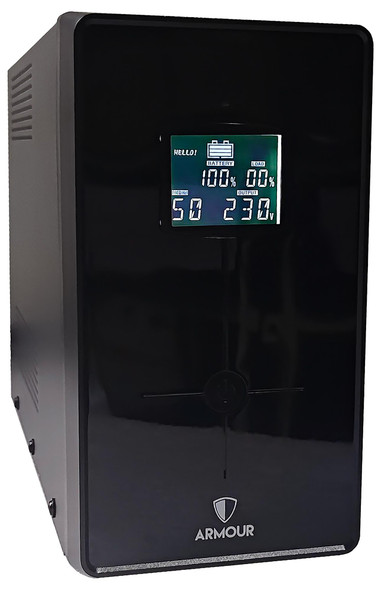
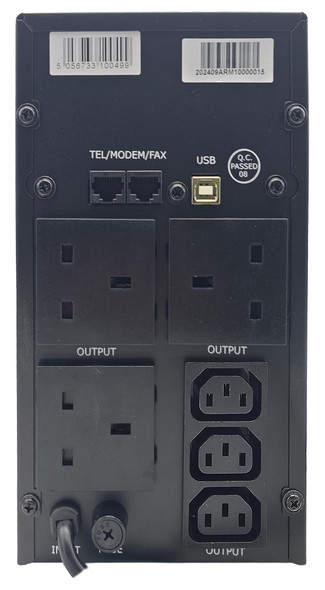
Armour 1500VA UPS 900W Battery Backup – LCD, 6 Outlets & USB Monitoring
VIDA


Armour 2000VA UPS 1600W Battery Backup – LCD, Pure Sine Wave & USB Monitoring
VIDA


Armour 650VA UPS 390W Battery Backup – 2 UK Plugs, RJ45 & USB Monitoring
VIDA